
|
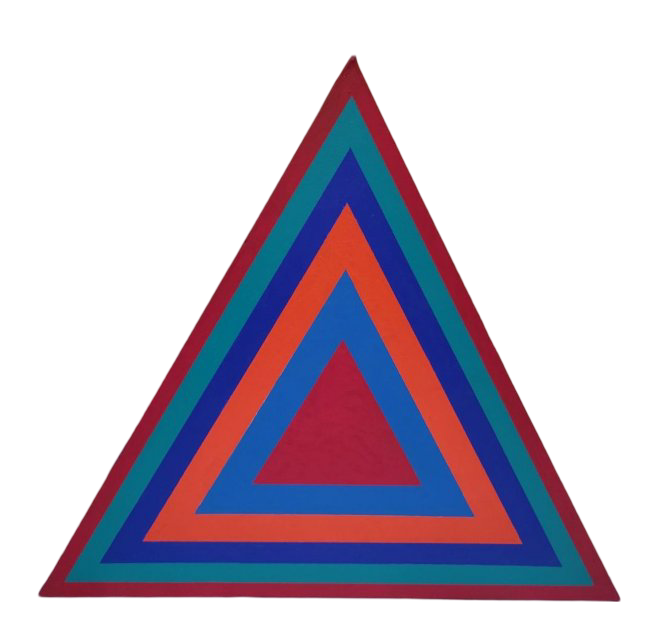
Number One Triangle
, 2023, Acrylic on canvas, 37" x
37"
|
|
|
by Chuck Bauer
|
|
| Original construction and design, 1970. |
Each color area occupies the same physical area. Additionally for anyone who can observe clearly, and notice a "bounce" at some edges, here is what's happening: Where complementary (or near complementary) colors share a strong border, ordinary constant eye movements (saccades) cause the borders to appear to jump along with the eye movements. Because the colors are complementary, the retinal responses to the two colors are opposites, making the retinal response changes caused by the eye movements to be as large as possible and, therefore, as perceptionally prominent as possible. More saturated colors produce a stronger "bounce". Saturated colors saturate the retina, exhausting the cones that respond to the color. When the eye moves to the adjacent, complementary color, the response to that complementary color is even stronger because the cells that respond to its complement (its opposite) have been depleted.


